Bypass & STS
Static bypass vs maintenance bypass in a three-phase UPS
A static bypass is an automatic, solid-state path inside the UPS that moves the load to the bypass supply when the inverter fails, is overloaded or is shut down. A maintenance bypass is a manual breaker path around the UPS that keeps the load powered while the UPS is isolated for service. Both paths feed the load unconditioned power.
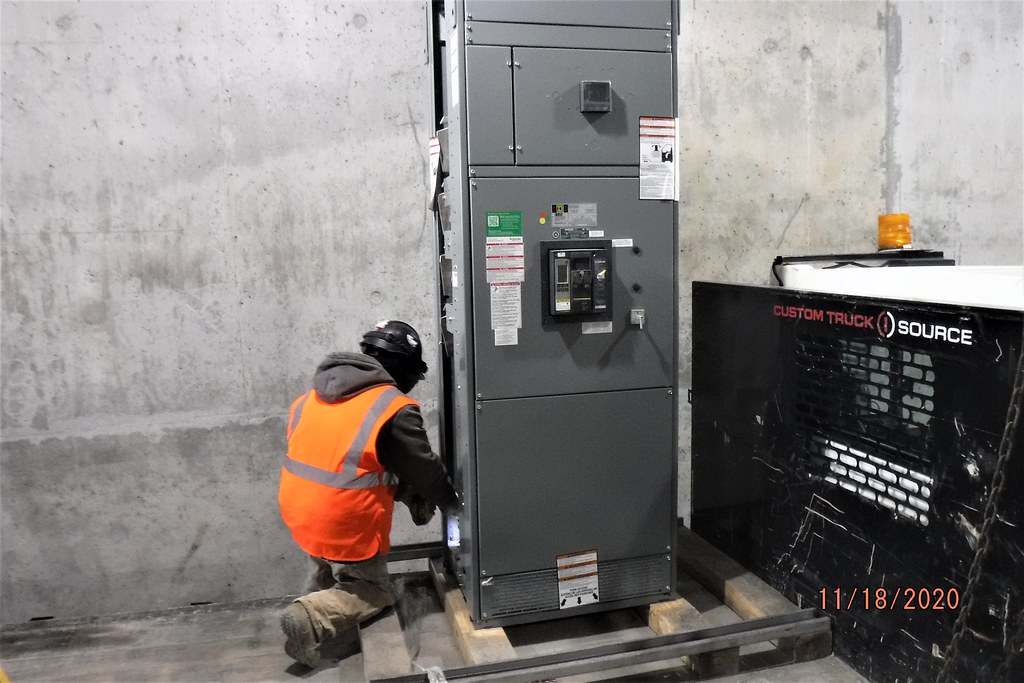
Static bypass and maintenance bypass side by side
Vertiv's Liebert APM2 manual and Schneider's Galaxy VS manual describe the same two paths in their own terms. The table sets them side by side. A static transfer switch (STS) is a separate device that selects between two sources; see Where an STS fits, below.
| Static bypass | Maintenance bypass | |
|---|---|---|
| What it is | A static switch inside the UPS (Liebert APM2); Schneider calls it the static bypass switch module on the Galaxy VS | A maintenance bypass breaker (MBB), an integrated option on the APM2 150 kVA 208 V and 300 kVA frames; on the Galaxy VS, a maintenance bypass disconnect device (MBB) in an external panel, cabinet or third-party switchgear, plus an internal maintenance disconnect (IMB) |
| How it engages | Automatically when the inverter fails, is overloaded or is shut down manually (APM2); on the Galaxy VS, on request from the display or forced by the UPS or the inverter OFF button | By closing the MBB or IMB, a manual operation |
| Transfer | Without interrupting the load; under 20 ms of interruption if inverter and bypass are not synchronized (APM2) | With no interruption in power to the load (APM2) |
| Power to the load | Unconditioned power from the bypass source (Galaxy VS, forced static bypass) | Unconditioned power from the bypass source (Galaxy VS) |
| Batteries | Not available in forced static bypass; in requested static bypass, a utility outage sends the UPS to battery (Galaxy VS) | Not available (Galaxy VS) |
| What can be serviced | Nothing is isolated | With the IMB: power modules, the static bypass switch module and the controller box; with the external MBB: the entire UPS (Galaxy VS) |
What triggers a static transfer
Vertiv lists the triggers for the APM2: the inverter fails, the inverter is overloaded, or it is shut down manually; the static switch then moves the load to the bypass without interrupting it. Schneider separates two cases on the Galaxy VS. Requested static bypass follows a command from the display, and if a fault is detected the UPS goes back to double conversion or to forced static bypass. Forced static bypass follows a command from the UPS itself, or someone pressing the inverter OFF button.
Overload is one automatic trigger. Schneider's White Paper 75 explains that the points at which a module transfers to static bypass are chosen by the manufacturer to protect the load and the module, and gives a typical rating as an example: a module that carries 125% of its rated load for 10 minutes, or until a component reaches a given temperature, then transfers to static bypass if the load has not returned to normal. The exact limits are in each model's specification.
One mode uses the static bypass path on purpose. In the Galaxy VS eConversion mode, the UPS supplies the active part of the load through the static bypass while the utility is within tolerance, with the inverter running in parallel; that is an efficiency mode, not a fault. Whether a transfer to bypass is allowed at all depends on the bypass tolerance settings covered further down.
What the load is exposed to on bypass
- Unprotected power. White Paper 75 lists it first among the drawbacks of an N (capacity) design: when the module breaks down, the load is transferred to bypass operation, exposing it to unprotected power, and the same happens during maintenance of the UPS, batteries or downstream equipment.
- No battery behind the load. On the Galaxy VS, the batteries are not available as an alternate power source in forced static bypass, internal maintenance bypass or external maintenance bypass.
- A short break if out of sync. The APM2 transfer from inverter to bypass carries a transitory interruption of less than 20 ms if the two are not synchronized.
- The EPO stops the bypass too. On the APM2, the emergency power off shuts down the rectifier, the inverter and the static bypass, but does not disconnect the mains input inside the UPS.
In parallel systems the Galaxy VS adds one more state, static bypass standby: a unit that cannot enter forced static bypass turns its output off while the other units carry the load, and if they cannot, the whole parallel system transfers to forced static bypass.
Maintenance bypass: the order matters
White Paper 75 states the design rule: the maintenance bypass is a normally open circuit that can only be closed when the UPS module is in static bypass, and the design has to prevent it being closed at any other time. Once it is closed, Vertiv notes, the maintenance bypass parallels the UPS static bypass.
Vertiv's APM2 procedure shows the sequence in outline. To go into maintenance bypass: transfer the UPS to internal bypass, release the interlock and close the MBB, then open any battery breakers, then the rectifier input, bypass input and output breakers (RIB, BIB, MIB) to isolate the UPS. To come back: close those breakers, let the UPS start in internal bypass and verify it is there, then open the MBB and transfer to inverter. Vertiv warns that opening the MBB without the UPS on internal bypass drops all output power to the connected equipment.
This is an outline, not a procedure: follow the manual for your model and frame. Schneider, for example, limits the Galaxy VS internal maintenance disconnect to single systems and simplified 1+1 parallel systems without an external maintenance bypass. Bypass transfers are part of the three-phase UPS service we schedule.
Static bypass and maintenance bypass by model
| Model | Bypass | Redundancy and paralleling | Status | Source |
|---|---|---|---|---|
| APC Galaxy VS GVSUPS20KFS (20 kW, 208 V) and GVSUPS100KGS (100 kW, 480 V) | Built-in static bypass; maintenance bypass cabinet offered as an accessory | Single units listed as non-redundant ("Redundant: No"); parallel kit sold separately (GVSOPT006) | Current | Schneider Electric Canada, GVSUPS20KFS |
| APC Easy UPS 3S E3SUPS20KFBS (20 kVA, 208 V, internal batteries) | Built-in static bypass | Not stated | Current | Schneider Electric Canada, E3SUPS20KFBS |
| APC Symmetra PX SY40K40F (40 kW N+1, 208 V) | Built-in static bypass | Listed as redundant ("Redundant: Yes", sold as 40 kW N+1) | Partly discontinued: December 31, 2025 (150 kW scalable to 250 kW model) | Schneider Electric Canada, SY40K40F |
| Eaton 93PM 93PM 208V (North America) | Integrated maintenance bypass, wall-mounted or floor-mounted bypass as options | External parallel up to 8 UPSs | Current | Eaton, 93PM 208V UPS page |
| Eaton 9355 9355, 10 to 30 kVA | Automatic bypass on overload or UPS failure; maintenance bypass switch | Parallel up to four UPSs (HotSync) | Current | Eaton, 9355 UPS page |
| Eaton Power Xpert 9395P Power Xpert 9395P, 200 to 1,200 kVA | System bypass module included; external maintenance bypass as an option | N+1 capable; parallel up to 4 UPSs with distributed bypass, 8 with a system bypass module | Current | Eaton, Power Xpert 9395P page |
| Eaton 9395XC 9395XC, 1,125 to 2,250 kW, 480 V 3-wire | External maintenance bypass, maintenance bypass module as options | Parallel up to 2 UPSs (3 MW) | Current | Eaton, 9395XC UPS page |
| Vertiv Liebert APM2 Liebert APM2 UL, 208 V (data sheet SL-71300) | Hot-swappable bypass module; integrated maintenance bypass up to 150 kVA (208 V) or 300 kVA (480 V) | Modular redundant; parallel up to 4 units | Current | Vertiv Canada, Liebert APM2 UL UPS 208V; Vertiv, Liebert APM2 data sheet SL-71300 |
| Vertiv Liebert EXL S1 Liebert EXL S1 (brochure for 625 to 800 kVA) | Static switch per module (distributed bypass); maintenance bypass cabinet | Parallel up to 8 units, distributed or centralized | Current | Vertiv, Liebert EXL S1 625-800 kVA brochure; Vertiv, Liebert EXL S1 page |
| Vertiv Liebert ITA2 Liebert ITA2 3-phase, 5 to 40 kVA, 208 V | Optional maintenance bypass cabinet | Up to 80 kW with parallel systems | Current | Vertiv, Liebert ITA2 3-phase UPS page |
| Vertiv Trinergy (newer range) Vertiv Trinergy, the newer range that follows the Trinergy Cube (brochure SL-71331) | Continuous-duty static bypass switch | Not stated | Partly discontinued | Vertiv, Trinergy UPS brochure SL-71331 |
| Mitsubishi Electric 9900B 9900B, 300, 500 and 750 kVA at 480 V | Not stated | Parallel up to 8 units with a CLC; distributed bypass for multi-module | Current | Mitsubishi Electric, 9900B UPS |
| Mitsubishi Electric 9900AEGIS 9900AEGIS, 80 to 225 kVA at 480 V | Internal static bypass, dual input | Parallel redundant or capacity, up to 4 modules | Current | Mitsubishi Electric, 9900AEGIS UPS |
| ABB TLE Series ABB TLE Series 40-150 kW and 160-1000 kW UL | Built-in static bypass switch (40-150 kW) | Redundant Parallel Architecture: up to 6 units (to 900 kW for the 40-150 kW model) | Current | ABB US, TLE Series 40-150 kW |
| Socomec MASTERYS GP4 MASTERYS GP4, 10 to 250 kVA/kW | Static bypass, internal maintenance bypass switch, dual input mains | Fault-tolerant power bricks (60-250 kW); parallel-ready | Current | Socomec, MASTERYS GP4 |
| Socomec MODULYS GP MODULYS GP, 25 to 600 kVA (400 V) | Hot-swappable bypass module | Not stated | Current | Socomec, MODULYS GP |
| XPC M90U-80 M90U-80, 15 to 80 kW at 208/120 V | Maintenance bypass in the same cabinet | Not stated | Current | XPC, M90U-80 |
Sources, checked October 3, 2026: values as each manufacturer publishes them for the model shown; “Not stated” means the page we read does not give the value.
Built in or in a cabinet
Schneider lists a built-in static bypass on the Galaxy VS, Easy UPS 3S and Symmetra PX, and sells a maintenance bypass cabinet for the Galaxy VS as an accessory. Vertiv builds the maintenance bypass into the Liebert APM2 up to 150 kVA at 208 V or 300 kVA at 480 V, and offers a cabinet for the ITA2. Socomec's MASTERYS GP4 has an internal maintenance bypass switch, and XPC puts the M90U-80's maintenance bypass in the UPS cabinet. On the large Eaton units the maintenance bypass is external: Eaton lists it as an option for the 9395P and 9395XC, alongside PDU, RPP and STS options.
Bypass in parallel systems
When units run in parallel, the bypass is either centralized in one cabinet or distributed across the units. Eaton allows up to 4 Power Xpert 9395P units with distributed bypass and up to 8 with a system bypass module. Vertiv's Liebert EXL S1 uses a static switch in each module (distributed bypass) for up to 8 units, and Mitsubishi describes a distributed bypass design for multi-module 9900B systems. ABB's Redundant Parallel Architecture on the TLE Series works without a centralized bypass or master control, and Socomec's MODULYS GP has no centralized parallel control and a hot-swappable bypass module.
Bypass settings to check at start-up
The static bypass only takes the load when the bypass supply is inside its tolerance window. Schneider lists a bypass voltage tolerance of plus or minus 10% for the Galaxy VS. Vertiv lets the Liebert APM2 upper limit be set to 10, 15 or 20% (15% by default) and the lower limit from 10 to 40%. On a generator-fed bypass, those settings decide whether a transfer is allowed.
Where an STS fits
An STS sits downstream of two UPS systems or two sources and switches the load between them; it belongs to a dual-path (2N) design rather than to the UPS. Eaton lists STS among the options for the 9395P and 9395XC.
Bypass and transfer tests belong in each preventive maintenance visit, and frames with a built-in static bypass are listed in the three-phase range.
Frequently asked questions
What is the difference between a static bypass and a maintenance bypass?
One is automatic and inside the UPS, the other manual and around it. The static switch takes over by itself when the inverter cannot carry the load; the maintenance bypass breaker is closed by a person, after a transfer to static bypass, so the UPS can be isolated and serviced.
Is the load protected when the UPS is on bypass?
Not by the inverter. The load runs on the bypass source; Schneider's White Paper 75 calls it unprotected power, and on the Galaxy VS the batteries are not available in forced static bypass or maintenance bypass. In requested static bypass, a utility outage sends the Galaxy VS to battery.
Why must the UPS be in static bypass before the maintenance bypass breaker is closed?
White Paper 75 describes the maintenance bypass as a circuit that can only be closed when the module is in static bypass. Vertiv's APM2 procedure transfers the UPS to internal bypass first, and warns that opening the MBB without internal bypass drops the output.
Does the APC Galaxy VS have a static bypass?
Yes. Schneider lists a built-in static bypass on the Galaxy VS (GVSUPS20KFS, GVSUPS100KGS), with a maintenance bypass cabinet sold as an accessory.
Does the Vertiv Liebert APM2 have a maintenance bypass?
Vertiv offers an integrated maintenance bypass up to 150 kVA at 208 V or 300 kVA at 480 V, and the APM2 bypass module is hot-swappable.
How many Eaton 9395P units can share a bypass?
Eaton lists up to 4 units with distributed bypass and up to 8 with a system bypass module.
Is a static transfer switch the same as a static bypass?
No. The static bypass is inside the UPS and transfers the load to the bypass supply; an STS is a separate device that switches the load between two independent sources.
Related guides and systems
Request a system quote
Tell us the application and we reply within 4 business hours with the sizing, the right system, the installation and a written quote. Three-phase installs usually need a licensed electrician, so let us know if you have one.
Brand names are trademarks of their owners and are used only to identify the equipment we service. We are not the manufacturer and are not affiliated with it.