Case study
Challenging a marine UPS battery proposal on runtime density and service access
An anonymized proposal-stage review of front-terminal battery sizing in a constrained cabinet
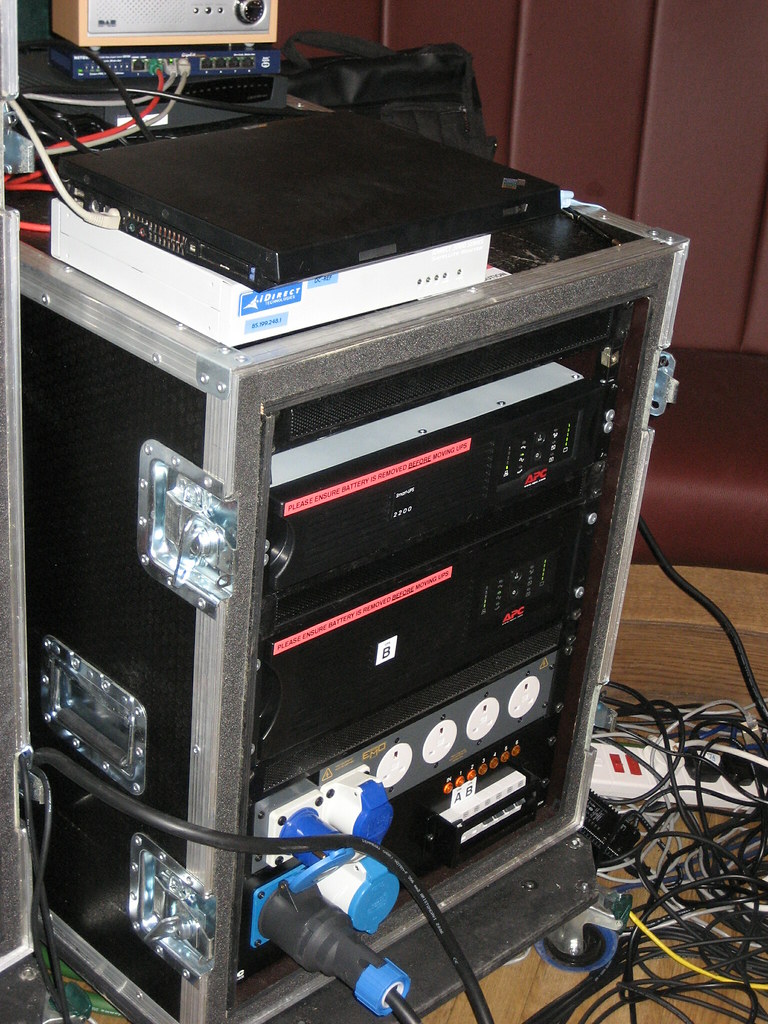
An anonymized marine-infrastructure proposal reached us with a battery selection that appeared conservative in the wrong direction. A larger front-terminal battery seemed capable of providing better runtime within the available footprint, yet it had not been selected. We challenged the sizing and asked for the decision basis. The field record does not identify the operator, site, UPS, cabinet, proposed battery, load, runtime or final procurement result. It records a proposal-stage engineering question, not an installed outcome.
No runtime improvement is claimed, and no exact battery is recommended. The proposal-stage boundary lets a buyer or engineer test whether a proposed string uses the cabinet effectively while preserving voltage, discharge performance, weight, heat, protection, terminal access and maintainability.
Operating problem
Battery proposals are often summarized by nominal voltage and amp-hour capacity. Those values are necessary but insufficient for UPS autonomy. A UPS supports an approximately constant-power load, so current increases as battery voltage falls. The selected block must be checked against manufacturer constant-power data at the required duration, end voltage and temperature. The string count must match the UPS DC bus and approved range. Aging allowance, temperature correction and design margin must be stated separately so that the apparent reserve can be audited [1].
Marine infrastructure adds practical constraints. The battery cabinet may sit in a limited electrical room with defined access paths, corrosion controls, ventilation, structural loading and service windows. A battery that produces more runtime on paper can still be unsuitable if it reverses terminal orientation, blocks removal, exceeds shelf or floor loading, conflicts with cable bend radius, increases available fault current beyond protection, or cannot be serviced safely from the front.
Front-terminal batteries place both terminals on the accessible face. In a correctly designed cabinet, this can make connection inspection, torque verification and ohmic testing easier than with top-terminal blocks. It can also improve the use of a narrow rack or cabinet. The configuration is not automatically superior; the exact block and enclosure still require a fit and protection review [2].
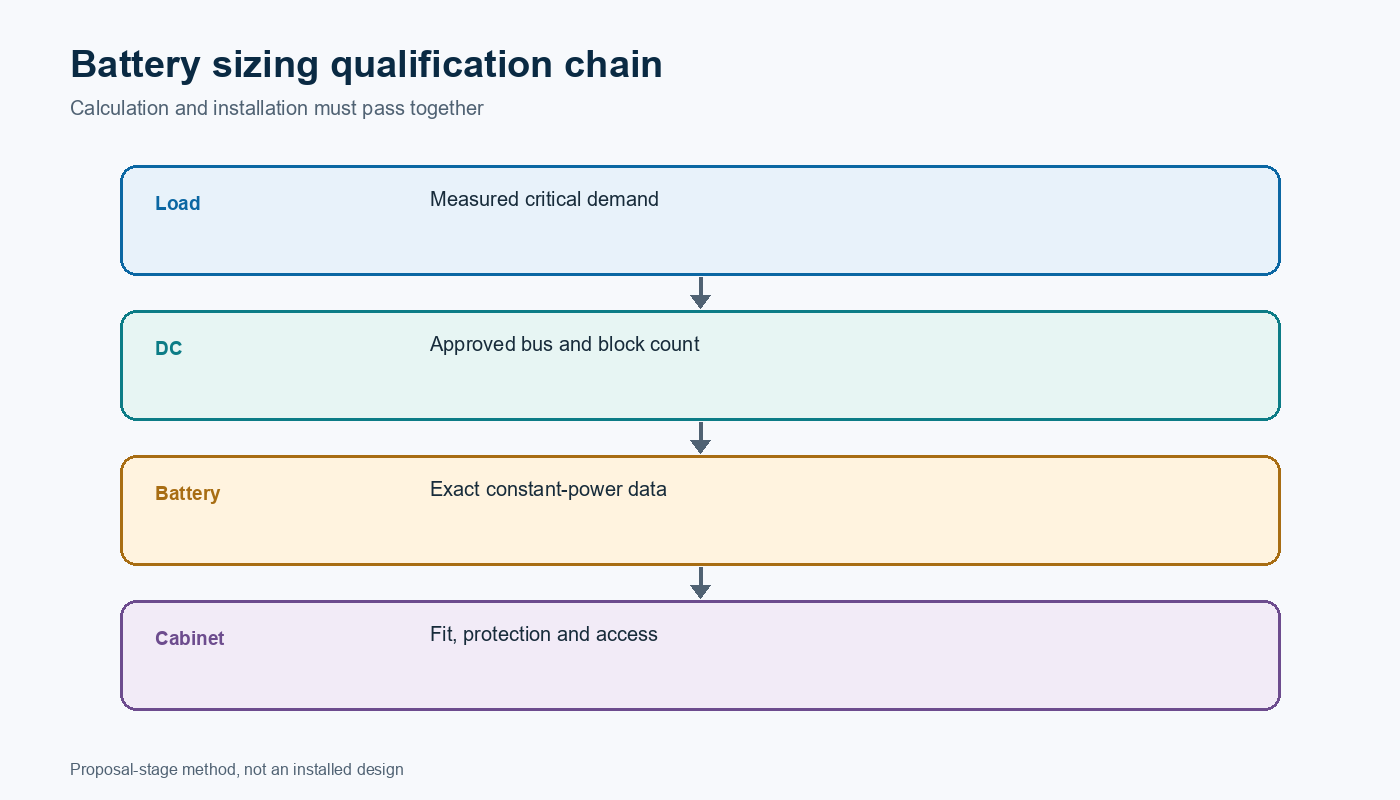
The design is not complete when the energy calculation passes. Electrical duty, cabinet fit, protection and service access must pass together.
Why the larger block was questioned
The field note says we asked why the larger front-terminal batteries had not been selected when they appeared to offer better runtime for the footprint [3]. "Appeared" is the correct word. A larger model may have a stronger discharge table, but its benefit depends on the exact design point. Its dimensions and weight may reduce the number of blocks or violate an enclosure limit. A change in internal resistance can alter prospective short-circuit current. A higher-capacity string can also extend recharge time beyond the operational recovery requirement.
The question was therefore not "Why did the vendor choose the smaller battery?" as a challenge to professional judgement. It was "Which constraint made the smaller battery the better compliant selection?" A defensible answer might be shelf rating, block count, charger current, seismic restraint, class requirement, procurement availability, access, fault duty or a manufacturer-approved cabinet list. If no such constraint exists, the larger block deserves a complete comparison.
Required design basis
The proposal should identify the measured or otherwise justified critical load, power factor where relevant, UPS efficiency on battery, required autonomy, DC bus, minimum end voltage, block count, number of strings, ambient design temperature, aging factor, design margin and recharge objective. Each input needs a source. A requested runtime is not the same as a verified load, and a UPS nameplate is not the battery load.
The exact battery table then supplies watts per block or watts per cell at the selected duration and end voltage. The calculation must preserve the table revision and temperature basis. Any interpolation needs to be documented. Manufacturer design life is not a runtime input and does not establish replacement age.
| Design input | Evidence | Proposal-stage acceptance rule |
|---|---|---|
| Critical load | Metering, UPS trend or justified load schedule | Use peak critical demand plus documented growth, not summed nameplates |
| DC configuration | UPS manual and installed one-line | Block count and parallel strings stay within the approved range |
| Battery capability | Exact constant-power table | Published capability exceeds corrected demand at the chosen end voltage |
| Temperature and aging | Site condition and stated factors | Corrections are visible and are not hidden inside one margin |
| Cabinet fit | Manufacturer drawing and cabinet confirmation | Every block, terminal, cable, restraint and service clearance fits |
| Protection | Battery and system short-circuit data | Isolation and interrupting ratings are adequate for the final topology |
| Recovery | Charger data and operating requirement | Recharge time is calculated for the increased capacity and site duty |
Our battery-sizing reference emphasizes that a mathematically adequate battery is not a finished design until the exact quantity, orientation, terminal access, clearances, weight, heat, cabling, protection and service path are verified [1].
Comparing the two proposal paths
The smaller front-terminal block may be the correct choice if it is the only model approved for the cabinet, supports the required autonomy with adequate margin, maintains the recharge target and preserves structural and electrical limits. Its lower energy may also reduce fault duty or replacement handling risk.
The larger block may be the stronger choice if it fits the same cabinet without reducing block count, offers materially better constant-power performance at the actual design point, keeps protection and charger limits intact, and improves autonomy without obstructing service. The comparison needs to use identical load, end voltage, temperature and aging assumptions.
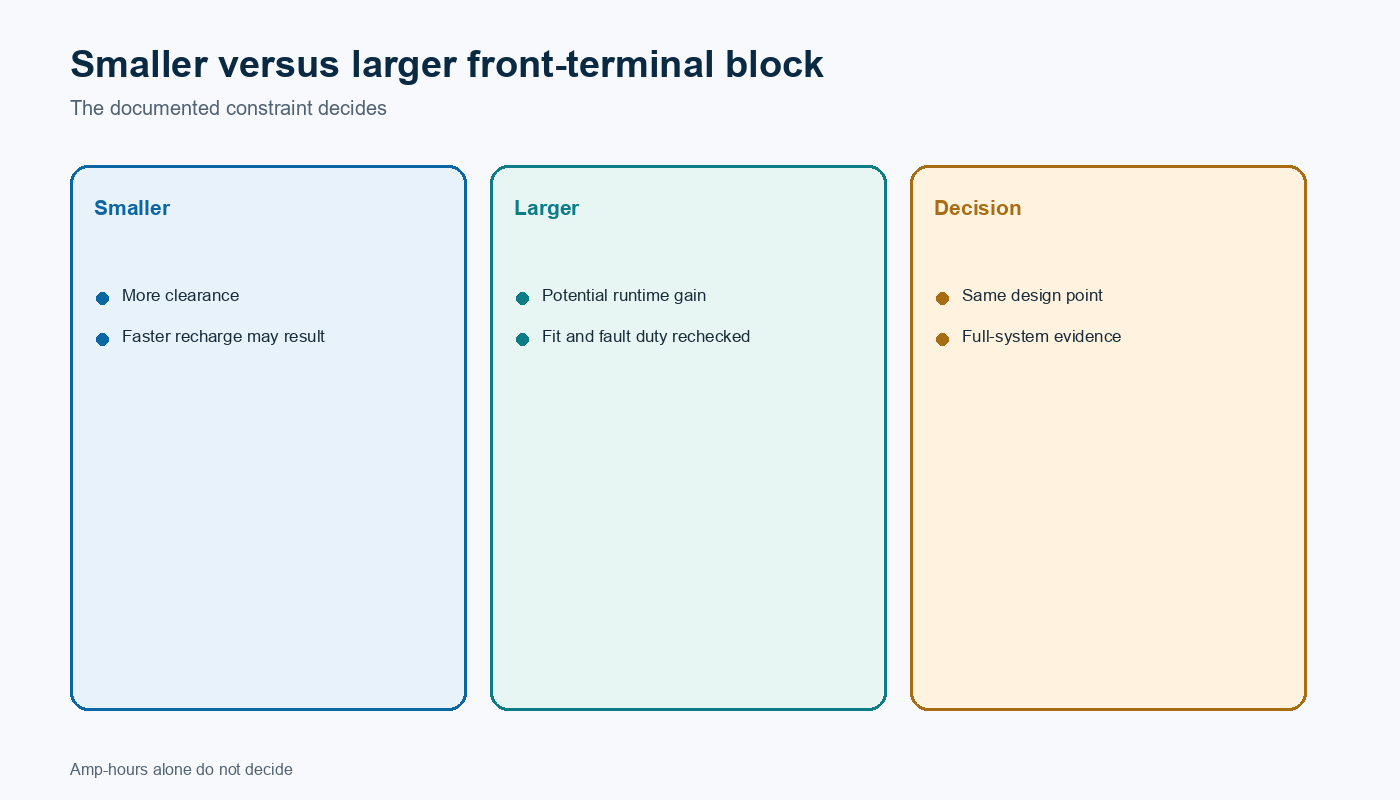
The larger battery earns selection through a complete system comparison, not by amp-hour rating alone. The smaller battery remains valid when a documented constraint governs.
| Question | Smaller block | Larger block |
|---|---|---|
| Runtime at design point | Must meet corrected demand with stated margin | Must show incremental autonomy from the exact discharge table |
| Cabinet | More clearance and lower handling weight may help | Fit, shelf load, cable reach and removal path require confirmation |
| Charger | Lower capacity may recover sooner | Recharge calculation must include the added capacity |
| Protection | Fault current may be lower | Short-circuit contribution and device duty require review |
| Serviceability | Front access still depends on cabinet layout | Larger case must not obstruct terminals or adjacent blocks |
| Procurement | Availability and lot consistency need confirmation | Same, without treating stock as proof of equivalence |
Facilities that need field confirmation can use our UPS battery repair and replacement service for installed-system measurements and cabinet verification. The service page is a contextual route, not the source of the anonymous case.
For early planning, the UPS runtime calculator can help organize load and autonomy inputs. Its output is preliminary. Final battery selection still requires the UPS manufacturer's approved DC range and the exact battery discharge data.
Marine-site constraints that belong in the proposal
The site survey should record ambient temperature, ventilation, corrosion exposure, water or salt ingress risk, floor and shelf capacity, anchorage, transport path, lifting method, clear working space and applicable classification or authority requirements. Marine facilities may also impose restricted access windows and operational dependencies that make recharge time or maintainability more important than a small increase in nameplate autonomy.
The cabinet review should be performed from controlled drawings and confirmed against the actual enclosure. A statement that the larger battery "fits" must include quantity, orientation, terminal position, shelf arrangement, cable length, protection device, heat clearance and removal path. If the cabinet manufacturer confirms fit, the confirmation should identify the battery model and drawing revision.
Verification after any approved change
Receiving inspection verifies model, quantity, date code, physical condition and lot consistency. Installation records polarity, string sequence, torque, cable routing, protective-device settings or ratings, monitoring points and initial block measurements. Commissioning confirms charger operation, alarms, battery detection and the restored operating state.
A controlled runtime test is the strongest proof of autonomy, but it must be authorized and planned. The record needs the supported load, initial charge state, temperature, start voltage, block or string measurements, stop criterion, elapsed time and recovery. If the site accepts only a functional test or calculated autonomy, the report must use that description and avoid calling runtime witnessed.
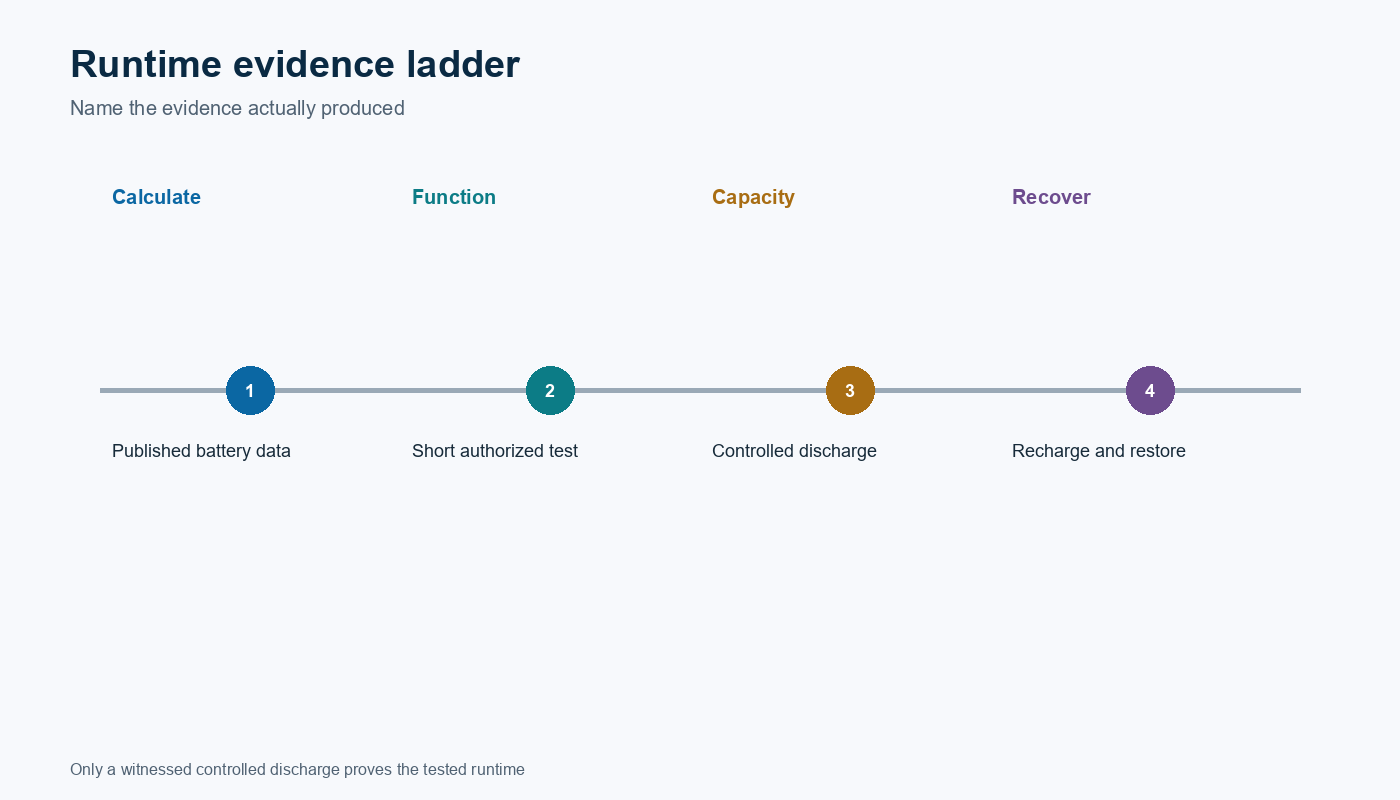
Calculated autonomy, a functional battery test and a witnessed capacity discharge are different evidence classes. The report should name the one actually completed.
Result and limitations
The field evidence supports one event: we challenged a proposed marine-infrastructure battery sizing and asked why the larger front-terminal option had not been selected when it appeared to provide better runtime density in the same space [3]. It supports a narrower rule: require a documented service-access and complete-system comparison, and challenge sizing that may leave useful autonomy unused.
The evidence does not support an exact runtime, model, final choice, installation or operating result. The proposal may have contained a valid constraint not preserved in the short field note. A new project must therefore repeat the full comparison instead of copying the apparent conclusion.
Information required before selecting the block
The final battery selection should remain open until the measured critical load, required autonomy, UPS DC limits, exact discharge tables, temperature and aging factors, cabinet drawing, block arrangement, structural limits, cable and protection review, charger recovery calculation, site environment and verification plan are recorded. The correct decision is the model that meets the required autonomy and recovery while fitting the approved enclosure, protection and service path. More capacity is useful only when the complete installed system can accept it.
Sources
- Internal engineering library, UPS Battery Sizing, Runtime Validation and String Design.
- Internal engineering library, Three-Phase and Data Center Power.
- Internal field evidence, Field Case Library: Engineering and Quoting Patterns, anonymized marine-infrastructure sizing entry.
- Internal engineering library, UPS Replacement Battery Varieties for Technical Selection and Retrofit Safety.
Request a system quote
Tell us the application and we reply within 4 business hours with the sizing, the right system, the installation and a written quote. Three-phase installs usually need a licensed electrician, so let us know if you have one.
Brand names are trademarks of their owners and are used only to identify the equipment we service. We are not the manufacturer and are not affiliated with it.