Case study
Flywheel UPS and generator integration protected MRI equipment from power disturbances
Caterpillar reports that Jefferson X-Ray selected a flywheel UPS, a generator set and a generator-start module for sensitive MRI and imaging equipment.
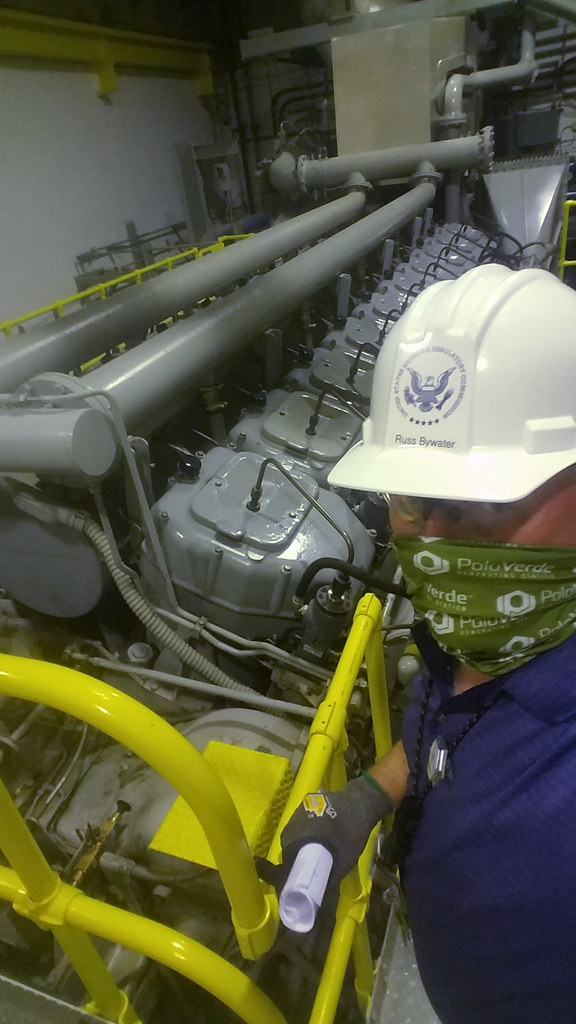
Caterpillar reports that Jefferson X-Ray selected a flywheel UPS, a generator set and a generator-start module for sensitive MRI and imaging equipment. [1]
Published operating context
The manufacturer source identifies the customer, application and intervention. It is the primary evidence for the project facts. Guidance for another site comes from the separately identified technical references. No manufacturer result is represented as an independent measurement.
The public manufacturer record identifies flywheel energy storage, a generator set and a generator-start module as the integrated solution. [1]
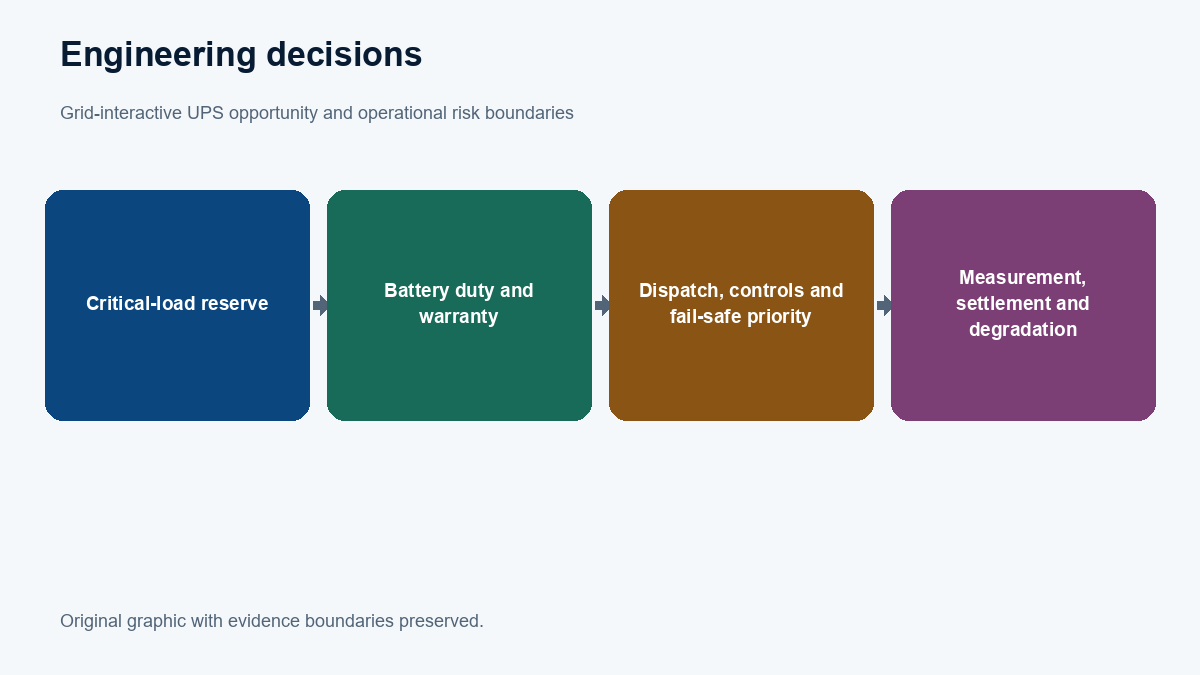
Figure 1: Published case sequence.
Reported challenge
The application concerns MRI power quality, harmonic cancellation and continuity during source disturbances. [1]
Operational risk is not limited to a complete outage. A voltage variation, short interruption, transfer, weakened battery, overload, high temperature or unowned alarm can interrupt the protected function. The first task for a similar project is therefore to measure load, read the event history and name the consequence of interruption.
Published response
The webpage does not disclose the as-built one-line, measured load, acceptance traces or observation period. [1]
The published sequence shows a solution selected for one context. It does not prove that the same rating, model, runtime or architecture fits elsewhere. A new project must confirm voltage, conductors, grounding, bypass, alternate source, clearances, environment and delivery route before purchase.
Figure 2: Evidence boundary.
Engineering qualification for another site
The design register separates known, measured, customer-stated, calculated and unresolved inputs. It covers normal watts and VA, peaks, runtime, power factor, phase loading, generator, temperature, cooling, batteries, communications and the work window. An unknown that changes safety, capacity, runtime or maintainability blocks firm selection.
States to prove include normal operation, source loss, stored-energy support, alternate source, static bypass, maintenance bypass, component isolation and return to normal. For each state, the record names the load path, remaining protection, reserve, permitted duration, alarms, switching authority and rollback condition.
Implementation controls
The purchase record binds the exact model, voltage, rating, batteries, bypass, accessories, network interface, certification, warranty and startup. A substitution requires a dedicated source and a fresh check of every criterion. Custom or non-cancellable equipment receives a separate release gate.
For intervention planning, review data-centre and critical UPS service. For equipment context, review UPS systems.
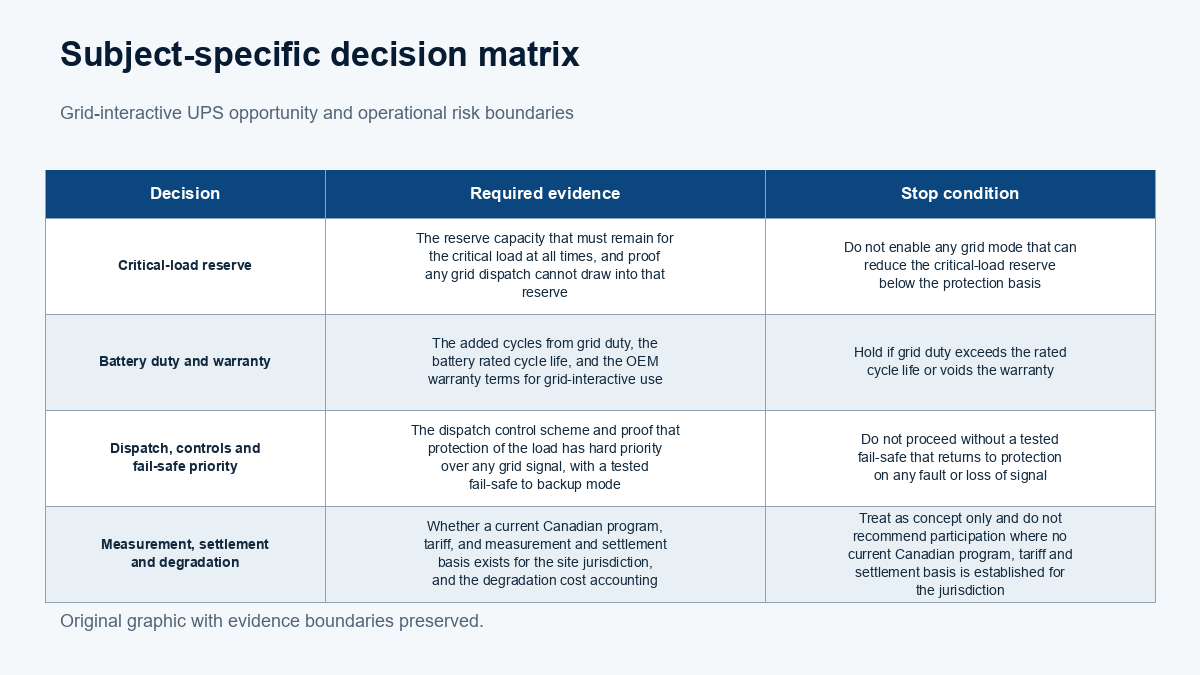
Figure 3: Case-specific decision matrix.
Reported results and measurement limits
The results above are manufacturer-reported. The public source is not an independent audit and may omit load profile, event logs, runtime tests, costs, failures, settings and observation duration. Those omissions do not disprove the published result, but they prevent conversion of that result into a guarantee for another site.
Records to carry forward
The closeout file retains the load survey, as-built one-line, models and serials, battery configuration, settings, firmware, transfer tests, alarms, deficiencies, corrections and final state. It also names the owner for alarms, updates, spares and the next lifecycle decision.
Subject-specific decision register
Four decisions govern this publication: mri load and disturbance tolerance, flywheel bridge duty, generator start and ups acceptance and harmonic and transfer evidence. They form a reviewable register instead of a generic checklist. Each row has an input, source, owner, acceptance condition and consequence when evidence is missing.
| Decision | Required evidence | Stop condition |
|---|---|---|
| MRI load and disturbance tolerance | The MRI system power draw (steady and gradient and RF peaks) in kVA and its ride-through and disturbance tolerance from the OEM | Hold until the MRI peak draw and disturbance tolerance are taken from the OEM data |
| Flywheel bridge duty | The flywheel rated power and bridge seconds versus the MRI peak and the generator start-and-accept time | Do not select if the flywheel bridge is shorter than the generator start time at the MRI peak |
| Generator start and UPS acceptance | The generator start time, its acceptance of the UPS step load and harmonics, and the transfer scheme | Hold if generator acceptance of the UPS input is not demonstrated |
| Harmonic and transfer evidence | Measured input harmonics and transfer and waveform test results against the MRI tolerance | Keep the deficiency open until harmonic and transfer tests meet the MRI tolerance |
The site survey records load, source, room, environment, bypass, delivery route and operating constraints [4]. Calculations and assumptions retain units, load state and source [5]. This connection prevents a catalogue value or a case outcome from becoming the default value for a new installation.
The state register separates normal operation, source loss, stored-energy support, static bypass, maintenance bypass, isolation and return [6]. It states what supplies the load, remaining protection, energized sources, permitted duration, alarms and the point where work must stop.
Monitoring identifies card, firmware, protocols, network segment, accounts, logs and alarm owner [7]. Read-only remains the starting point. A remote command or automated shutdown requires an approved need, dependency map and tested rollback.
Commissioning establishes criteria before testing and retains measurements, events, deficiencies, corrections and final state [8]. The service agreement states response, exclusions, spares, maintenance window, report and next lifecycle decision [9].
The cited field pattern from our own projects is used only for the comparable-project method [10]. It does not mean that we performed the manufacturer case. Customer facts, products, quantities and results remain attributed to the manufacturer source.
Sources
- Caterpillar, Jefferson X-Ray: Continuous Power for MRI Equipment. https://www.cat.com/en_GB/by-industry/electric-power/Articles/Testimonials/100-continuous-power-jefferson-xray.html
- Caterpillar, Cat Flywheel Uninterruptible Power Supply. https://emc.cat.com/n/api/pubdirect?media_string_id=LEHE0413-
- Internal engineering library, North American UPS Power Distribution, Grounding and Generator Compatibility.
- Internal engineering library, UPS Site Survey and Requirements Capture.
- Internal engineering library, UPS Engineering Calculations and Independent Design Verification.
- Internal engineering library, UPS Maintenance MOP Safety Boundaries and Go-No-Go Criteria.
- Internal engineering library, UPS Monitoring Cybersecurity and Network Integration.
- Internal engineering library, UPS Commissioning and Acceptance Testing.
- Internal engineering library, UPS Service SLA Design and Coverage Scoping.
- Internal library, Field Case Library: Engineering and Quoting Patterns.
Request a system quote
Tell us the application and we reply within 4 business hours with the sizing, the right system, the installation and a written quote. Three-phase installs usually need a licensed electrician, so let us know if you have one.
Brand names are trademarks of their owners and are used only to identify the equipment we service. We are not the manufacturer and are not affiliated with it.