Case study
EcoDataCenter: four Schneider Electric Galaxy VX UPS systems in a 2N data centre
An evidence-led review of Schneider Electric's published Galaxy VX deployment in Falun, Sweden
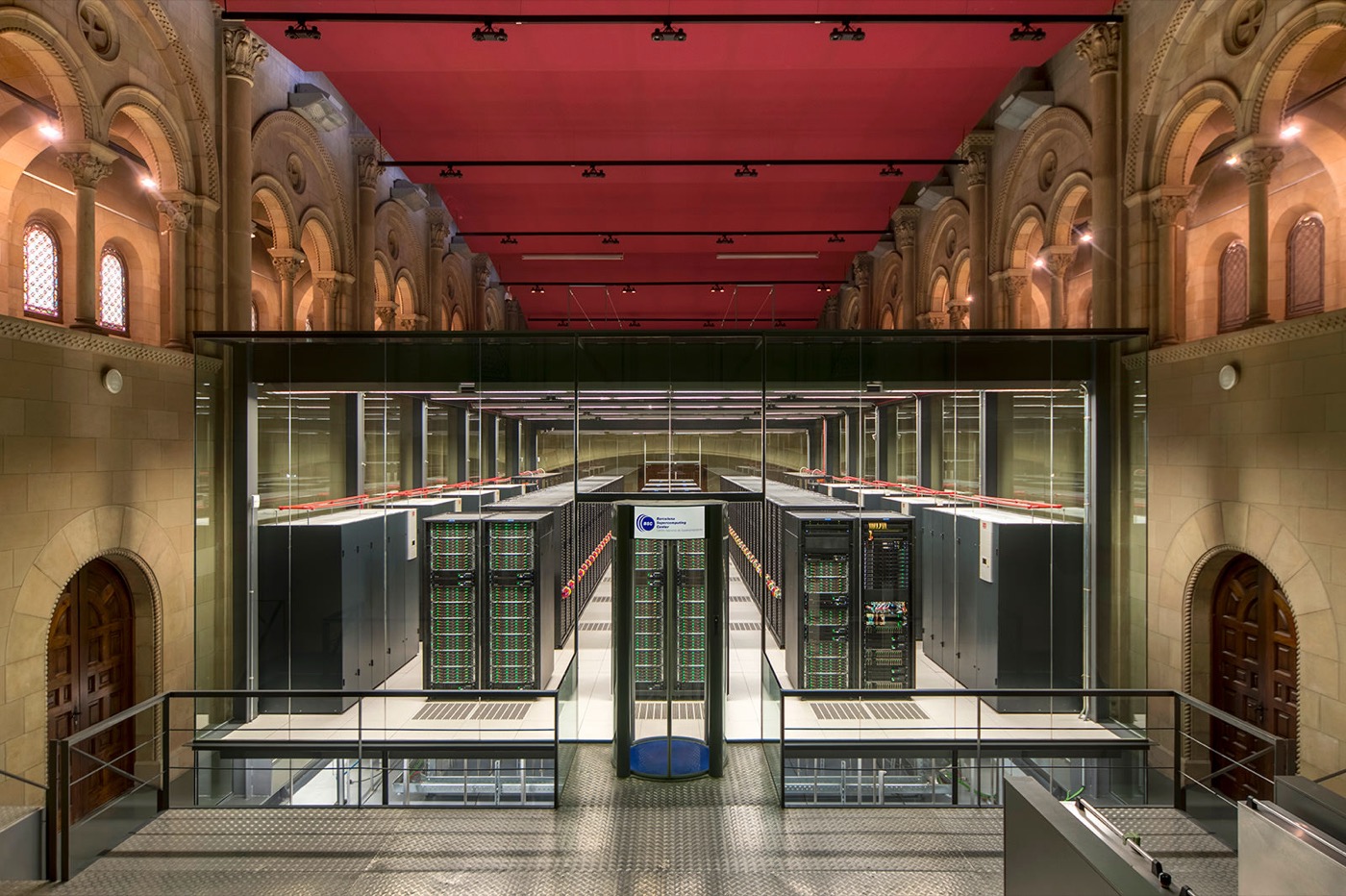
Schneider Electric reports four Galaxy VX UPS systems rated at 1,250 kW each at EcoDataCenter's 2N high-performance computing (HPC) colocation facility in Falun, Sweden. The manufacturer also publishes a 1.15 power usage effectiveness (PUE) and the possibility of 99 percent UPS efficiency in ECOnversion mode.
PUE compares the total energy used by a data centre facility with the energy used by its IT equipment over the same period. A published PUE of 1.15 represents a 1.15-to-1 facility-to-IT energy ratio, subject to the measurement period and boundary that Schneider does not disclose.
Source boundary: Schneider Electric published the project information analyzed here. ThreePhaseUPS did not design, supply, commission or audit the Swedish installation. All project results are attributed to Schneider Electric unless stated otherwise.
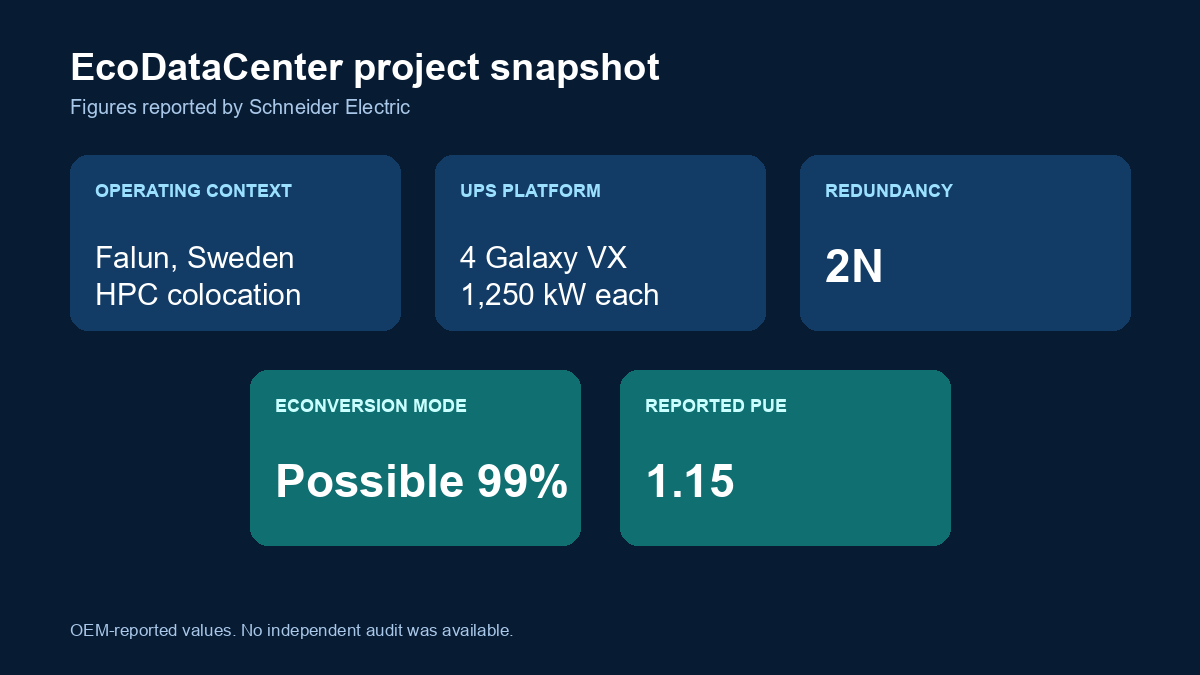
Figures published by Schneider Electric for EcoDataCenter. No independent audit was available for this analysis.
EcoDataCenter's Falun operating context
EcoDataCenter operates high-performance-computing colocation capacity in Falun, Sweden. Schneider describes a project that combined critical IT availability with an ultra-low-carbon objective. The facility needed reliable power management for customer servers, a low operating-energy burden, physical and cyber controls, and an infrastructure platform that could work with third-party systems.
EcoDataCenter's design linked power protection, digital supervision, cooling and heat reuse at the facility level. That boundary is necessary for a large three-phase UPS because its selection affects utility demand, generator behaviour, battery space, electrical losses, cooling load, distribution, maintenance access and monitoring.
Schneider's published equipment list includes Galaxy VX UPS systems, lithium-ion batteries, APC NetShelter racks, power distribution, sensors, computer room air handler (CRAH) units, chillers, air-handling equipment and heat pumps. The software and service layer includes EcoStruxure IT Advisor, EcoStruxure IT Expert and Connected Services Hub. Schneider states that the hub remotely monitors, troubleshoots and analyzes the critical facility continuously.
Availability, efficiency and connected-control risks
EcoDataCenter needed customer-server uptime and operational visibility, while additional resilience could increase equipment count, electrical loss and cooling demand. More redundant capacity can increase capital and idle losses. An aggressive efficiency mode can also change how the load interacts with the bypass and inverter.
The project also had a broader sustainability boundary. The data centre was intended to use renewable power and reuse heat, which made electrical efficiency relevant beyond the UPS room. Every kilowatt lost in conversion becomes heat that must be removed. At this scale, UPS operating mode, cooling efficiency and heat-recovery integration affect how much useful capacity reaches customer loads.
Cybersecurity was also part of the stated challenge. Connected monitoring can improve alarm response and capacity planning, but a UPS management interface can carry control or shutdown authority. A credible connected design therefore needs an exact asset and firmware inventory, segmented management networks, least-privilege identities, controlled remote support, central logging and tested recovery. Schneider identifies the monitoring platforms and service model but does not publish the network zones, protocols, identities or command rights.
What the published 2N and 99 percent figures do not prove
Schneider publishes four Galaxy VX UPS systems rated at 1,250 kW each, 2N redundancy, a 1.15 PUE and the possibility of 99 percent efficiency in ECOnversion mode. The published ratings identify the platform and reported performance, but they do not define the electrical design.
A 2N label means that two complete capacity paths are intended to carry the required load independently. It does not automatically prove that every utility source, generator, battery string, bypass path, output bus, cooling system, control circuit and rack feed is independent. The proof is state based: define the critical load, remove a named path, calculate what remains, trace shared dependencies to the load, and verify transfer and recovery under an approved test.
The public source does not disclose the as-built electrical one-line, actual IT load, phase balance, growth allowance, battery runtime, DC topology, bypass sequence, generator study, protection coordination, maintenance states or acceptance traces. It also does not state whether the four 1,250 kW ratings represent two units per path, how the load is shared, or which elements are common. No additional topology has been inferred.
Schneider lists lithium-ion batteries but does not publish the cabinet models, string arrangement, usable runtime, end-of-discharge basis, battery management system (BMS) architecture, fire interface or remaining autonomy with a string isolated. An exact replacement or runtime claim would require the full UPS and battery model, DC voltage, load, ambient conditions, age, firmware and test evidence.
Why Galaxy VX fit the published brief, and what was not compared
Schneider does not publish a formal options matrix or name rejected UPS alternatives. No evidence supports a claim that a particular competitor, topology or battery chemistry was evaluated and rejected. The selected architecture can be compared only with the requirements stated in the published project information.
Galaxy VX covers Schneider's published 500 to 1500 kVA range and addresses the required megawatt-class three-phase capacity. The 2N objective calls for duplicated capacity paths whose independence must continue through the downstream distribution. ECOnversion addresses conversion losses, while EcoStruxure monitoring relates power and capacity data to facility operation. Cooling and heat-recovery integration extend the design boundary beyond the UPS plant.
A Canadian project must begin with site evidence rather than EcoDataCenter's product choice. The minimum inputs are measured kW and kVA, power factor, harmonic content, voltage and frequency, generator behaviour, load criticality, growth, redundancy states, runtime, battery chemistry, footprint, cable entry, bypass arrangement, maintenance access, monitoring authority, environmental limits and required acceptance tests. Without those inputs, Galaxy VX is a candidate platform, not a completed solution. The Galaxy VX family and Canadian configuration options should be screened against those inputs.
Published EcoStruxure solution layers
Schneider describes an EcoStruxure for Cloud and Service Providers solution spanning three layers.
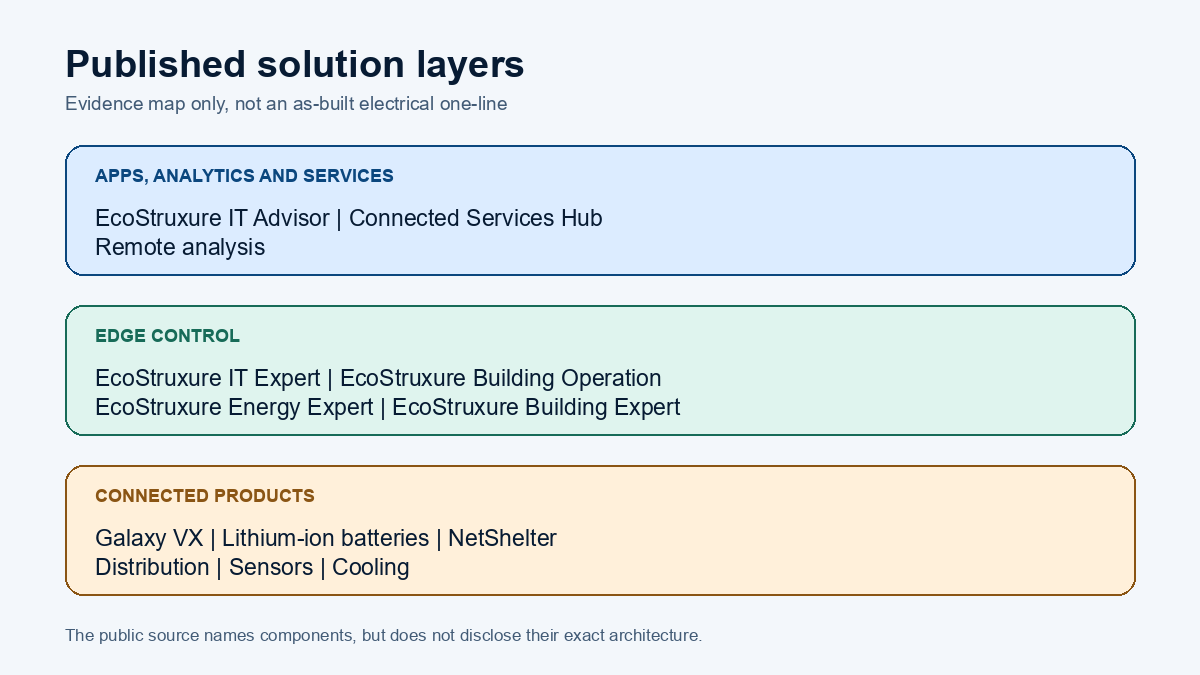
Components listed by Schneider. The diagram maps published evidence and does not represent an as-built electrical one-line.
At the applications and services layer, the published scope includes EcoStruxure IT Advisor and Connected Services Hub. At the edge-control layer, it includes EcoStruxure IT Expert, EcoStruxure Building Operation, EcoStruxure Energy Expert and EcoStruxure Building Expert. At the connected-product layer, it includes four Galaxy VX UPS systems, lithium-ion batteries, racks, distribution, sensing and cooling equipment.
Schneider's scope extended beyond the UPS plant to analytics, thermal systems and facility controls. The reported 1.15 PUE therefore cannot be attributed to the UPS alone. Cooling, distribution, operating load, climate and the measurement boundary all affect PUE. Heat reuse depends on the thermal system and local energy integration. Galaxy VX contributes to the electrical-loss profile as one part of the facility architecture.
Connected monitoring without public commissioning records
Schneider states that it was the chosen project partner, that the platform was intended to work with third-party solutions, and that Connected Services Hub provides continuous remote monitoring and analysis. The manufacturer also reports connected sensors and meter data used for operational-efficiency analytics and a sustainability index.
The available source supports the presence of connected monitoring but does not constitute a commissioning record. No factory-acceptance report, site-acceptance script, load-bank trace, battery discharge result, transfer waveform, bypass test, generator step test, thermal acceptance criterion or deficiency log is public.
Before energizing a Canadian installation, the commissioning plan should define the source and load conditions, calibrated instruments, synchronized UPS and facility logs, acceptance limits, alarm tests, load sharing, source transfer, battery response, bypass behaviour, monitoring failover, negative cyber-access tests, restoration and exception records. A live critical load should not be switched merely to prove a drawing. Testing requires an approved method of procedure, named roles, hold points, abort criteria and rollback. For an installed system, data-centre UPS maintenance and acceptance support starts with the exact model, electrical one-line and operating state.
Reported results and measurement limits
Schneider reports that four Galaxy VX UPS systems rated at 1,250 kW each can operate at 99 percent efficiency in ECOnversion mode. The manufacturer also reports a 1.15 PUE at 2N redundancy with waste-heat reuse, connected sensor and meter analytics, and energy made available to customer load rather than lost in the power path.
The 99 percent UPS efficiency and 1.15 facility PUE remain OEM-reported. Schneider does not publish the measurement interval, load percentage, operating-mode duration, meter locations, PUE boundary, weather normalization, baseline configuration or independent assurance. The available evidence does not support calculations of annual savings, avoided cooling, availability or payback.
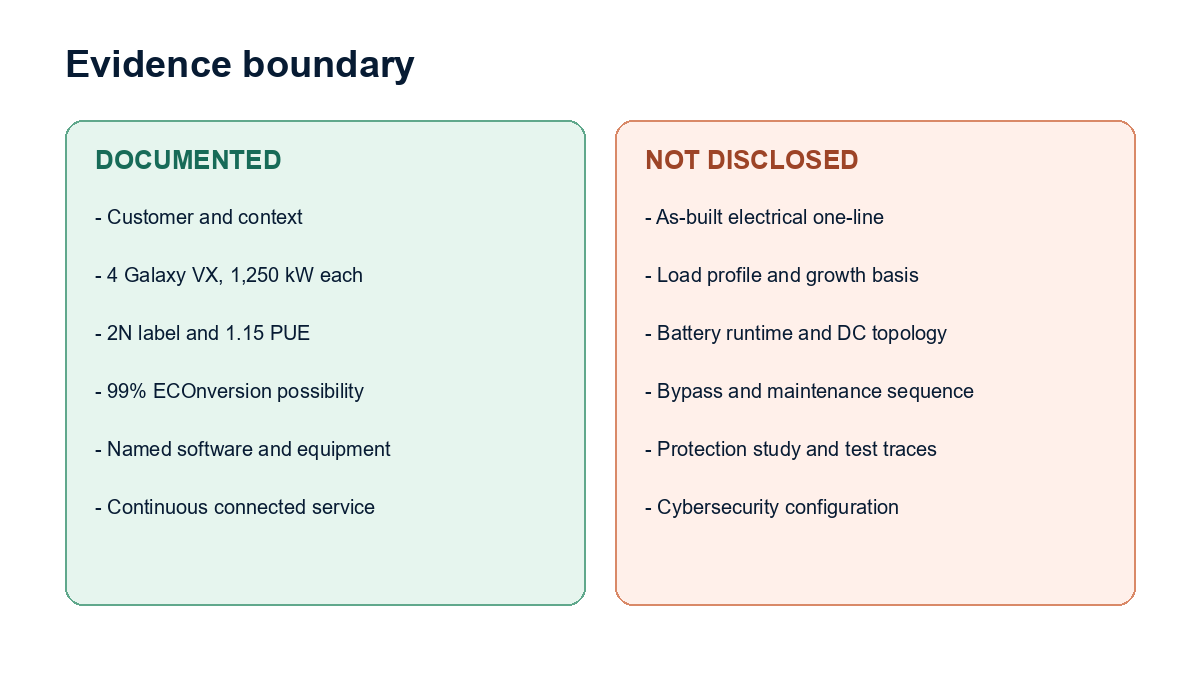
Published evidence identifies the equipment and reported results but does not provide a design, commissioning record or operating procedure.
EcoDataCenter confirms a Galaxy VX deployment at scale. It does not establish the PUE, efficiency, resilience or thermal result for another facility. Site performance depends on the load, electrical sources, operating modes, redundancy, batteries, distribution, climate, cooling and operating discipline.
Requirements for a Canadian Galaxy VX project
-
Define the system boundary before choosing the UPS. Separate critical IT load from cooling, controls, recharge and other essential loads. Record measured kW and kVA, power factor, harmonics, phase balance, peaks and documented growth.
-
Prove 2N by operating state. Trace both paths from source to every dual-cord and single-cord load. Include batteries, bypass, generator, cooling, controls, emergency power off (EPO), monitoring and downstream distribution. Record what remains during path isolation and restoration.
-
Treat efficiency mode as an engineering choice. ECOnversion is central to Schneider's reported result, but the exact source quality, load tolerance, transfer behaviour, fault clearing and operating policy must be confirmed for the installed model and site.
-
Engineer battery autonomy instead of copying chemistry. Lithium-ion was part of the published solution. A Canadian design still needs the exact ride-through purpose, generator start and transfer time, end-of-life margin, temperature, battery management system (BMS), fire interface, service isolation and acceptance test.
-
Separate monitoring from control authority. Inventory the exact interface and firmware. Use segmented management, read-only monitoring by default, named administrative access, central time and logs, controlled remote support and tested denial of unauthorized commands.
-
Make commissioning evidence part of procurement. The purchase specification should identify factory and site tests, witness points, load-bank scope, acceptance limits, required records, training, spares, warranty, cybersecurity deliverables and deficiency closure. A product data sheet is not an acceptance plan.
-
Keep commercial commitments behind the technical gate. Do not release a quote, tender equivalency, battery selection, procurement order, maintenance procedure or service contract until exact site inputs, deliverables, exclusions and approval authority are recorded. Compare Canadian Galaxy VX system configurations only after the technical schedule is complete.
Sources
- Schneider Electric, EcoDataCenter customer story
- Schneider Electric, Galaxy VX product range
- U.S. Department of Energy, Best Practices Guide for Energy-Efficient Data Center Design
- Internal engineering library, APC by Schneider Electric and Schneider Electric Three-Phase UPS: Product Lines, Faults and Service
- Internal engineering library, Three-Phase and Data Center Power
- Internal engineering library, UPS Redundancy, Bypass and Concurrent Maintainability
- Internal engineering library, UPS Monitoring Cybersecurity and Network Integration
Information required before selection
Before selecting a Canadian Galaxy VX configuration, confirm the exact load, source, voltage, runtime, redundancy states, bypass arrangement, physical constraints, monitoring boundary and acceptance requirements. A firm design, quotation or procurement release should follow only after those inputs are documented and approved.
Request a system quote
Tell us the application and we reply within 4 business hours with the sizing, the right system, the installation and a written quote. Three-phase installs usually need a licensed electrician, so let us know if you have one.
Brand names are trademarks of their owners and are used only to identify the equipment we service. We are not the manufacturer and are not affiliated with it.