Batteries
How long does a three-phase UPS battery last?
Short answer: most three-phase UPS battery strings reach end of useful life in three to five years, not the “ten-year” number printed on the cell. Heat, depth of discharge and age decide how close you get, and here is how to read the signs.
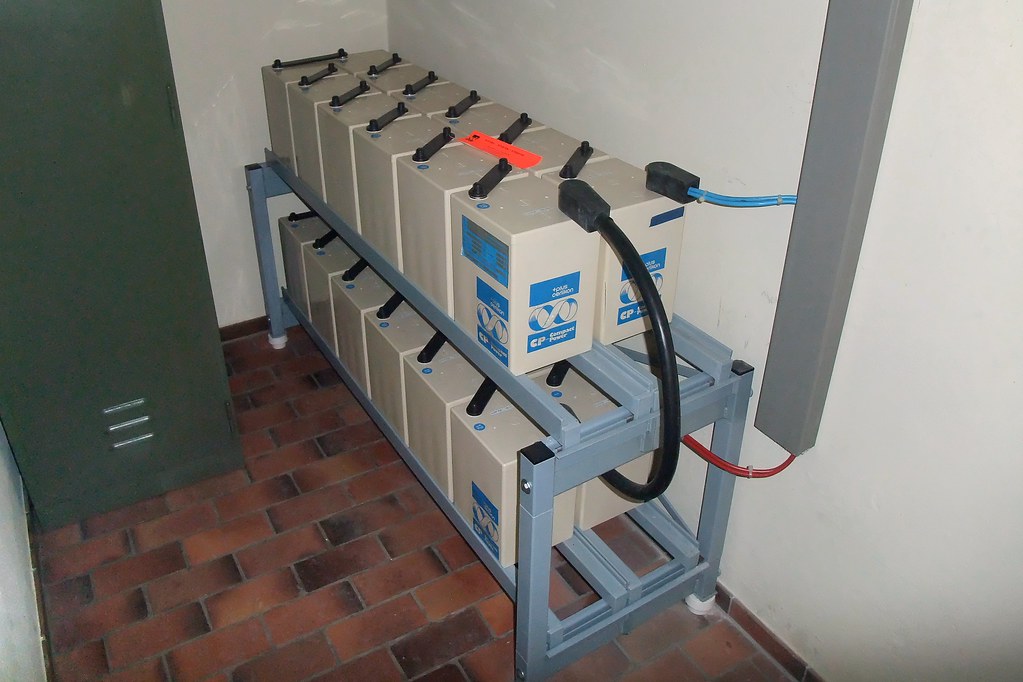
Design life is not service life
The number on a VRLA battery is its design life, a rating measured in a lab at a controlled 20 to 25°C, on float, with ideal charging. You will see cells marked “5-year” or “10-year” design life. That is not how long it will back your load. Service life, the years until the string can no longer carry the rated runtime, is shorter, often much shorter, because a real electrical room is warmer and busier than a lab.
The working rule we give every client: a 10-year design-life VRLA cell typically delivers three to five years of dependable service life, and a 5-year cell delivers two to three. Plan replacements on the service-life number, not the sticker. UPS battery life is set by the install conditions, not the label.
Heat is the number one factor
Temperature is the single biggest lever on UPS battery life, and it works against you. The rule of thumb from battery chemistry, an application of the Arrhenius relationship, is that every 10°C of sustained temperature above roughly 25°C cuts VRLA life by about half. A string rated for five years at 25°C can be down to two and a half at 35°C, and worse if the room runs hotter.
This is why a battery cabinet parked next to a heat source, or in a room where cooling drifts up over a weekend, ages faster than the calendar suggests. It is also why we log battery-compartment temperature, not just room temperature, during preventive maintenance. Keep the batteries near 25°C and you get the life you paid for; let them sit at 30 to 35°C and you are quietly buying replacements early.
The signs it is time to replace
Batteries rarely fail on a clean schedule. They drift, then they fall off a cliff. Watch for these:
Rising internal impedance. The most reliable early warning. As a cell ages its internal resistance climbs; a jump of 30 to 50% over the commissioning baseline means that cell is near the end, even if it still passes a casual voltage check. This is why baseline impedance readings at install matter.
Lost runtime. If a load that used to ride through for ten minutes now lasts four, the string has lost capacity. A discharge or capacity test confirms it.
Swelling, heat or leakage. A bulged case, a cell noticeably warmer than its neighbours, or any sign of electrolyte is a remove-now condition, not a watch item.
Age alone. A VRLA string past four to five years is on borrowed time regardless of how it tests on a good day. We treat age as its own trigger.
When it is time, fit the matching replacement battery for the unit, correct chemistry, voltage and Ah, from a source that stocks the right cell, such as the replacement battery catalogue online. The wrong substitute shortens life and can void the UPS warranty.
VRLA vs lithium-ion
Most installed three-phase UPS still runs on VRLA (valve-regulated lead-acid). Lithium-ion is now a real option on platforms like the Eaton 93PM, APC Galaxy VS/VL and the Vertiv Liebert range, and the trade-offs are worth understanding.
Life. A lithium-ion UPS battery typically lasts 8 to 12 years in service, two to three times a VRLA string, so it often outlives one full VRLA replacement cycle.
Size and weight. Lithium packs are roughly a third to a half the footprint and weight for the same energy, which frees floor space and eases structural limits.
BMS. Lithium ships with a battery management system that monitors every module for voltage, current and temperature, and disconnects on a fault. VRLA has no equivalent, monitoring is whatever you add.
Temperature tolerance. Lithium handles warm rooms far better, so the heat penalty above is much smaller. That alone can decide it for a site with marginal cooling.
Upfront cost. Lithium costs more to buy. Over a ten-year horizon the UPS battery replacement cost can favour lithium once you count the avoided VRLA swap, the labour and the floor space, but the cheque on day one is larger.
Monitoring, string replacement and thermal runaway
You cannot manage what you do not measure. Battery monitoring, impedance, per-cell voltage and temperature, turns a guess into a date, and it is the difference between a planned swap and an outage. On lithium the BMS does this; on VRLA, fit a monitoring system or test the string at every service visit.
Replace VRLA as a full string, not cell by cell. A new cell next to aged ones is dragged down to the weak cells’ level, so mixing old and new wastes the new battery and leaves a weak link. Budget the whole string, and before ordering 12 V AGM blocks used in UPS battery strings, read the Ah rating and terminal type off the blocks you are taking out.
One reason age and heat matter beyond runtime: VRLA thermal runaway. As a cell ages and dries out, its internal resistance and float current rise, it heats up, which raises current further, a feedback loop that, unchecked in a hot room, can vent, melt or in the worst case ignite a cell. Heat and age are exactly the conditions that push a tired string toward it, which is the safety reason, not just the runtime reason, to retire VRLA on schedule. For the full retirement decision, see three-phase UPS end of life.
String replacement, impedance testing and disposal records are part of UPS battery repair and replacement service.
Frequently asked questions
How long does a three-phase UPS battery last?
Most VRLA strings give three to five years of dependable service life, even when the cell is labelled 10-year design life. Lithium-ion typically lasts 8 to 12 years. The big variable is temperature: heat shortens both, lead-acid far more than lithium.
Why does my UPS battery die before its rated life?
The rating is a lab number at 20 to 25°C on float. A real electrical room runs warmer, and every 10°C above about 25°C roughly halves VRLA life. Heat, deep discharges and missed maintenance are why a “10-year” battery often lasts three to five.
What are the signs a UPS battery needs replacing?
Rising internal impedance against the baseline (the best early warning), lost runtime on a discharge test, any swelling or heat or leakage, and simply being past four to five years. Any one of these is reason to plan a replacement.
Is a lithium-ion UPS battery worth the extra cost?
Often, over a ten-year horizon. Lithium lasts two to three times longer, takes a third to a half the space and weight, includes a BMS, and tolerates warm rooms. The upfront UPS battery replacement cost is higher, but it can avoid a full VRLA swap and its labour.
Related guides and systems
Request a system quote
Tell us the application and we reply within 4 business hours with the sizing, the right system, the installation and a written quote. Three-phase installs usually need a licensed electrician, so let us know if you have one.
Brand names are trademarks of their owners and are used only to identify the equipment we service. We are not the manufacturer and are not affiliated with it.